
What is Summary? Types & Examples
A summary is a condensed version of the content that provides users with a quick overview of the key details. In summary, the author covers all the essence of a text using new words, skipping examples and avoiding unnecessary explanations.
A summary is commonly written at the beginning or at the end of the content. Plus, it is used in different types of writing, including marketing, academic, professional, and others. Its main purpose is to improve readers’ understanding, save their time, and help them quickly know the core concepts of a writing without reading it whole.
This blog will continue to elaborate on the key elements of a summary, its main types, and examples. Plus, we’ll go through a complete process on how to write a summary.
Types of A Summary
Summaries are categorized into different types, depending on their purpose and structure. Below we listed some main types of a summary.
1. Descriptive Summary
“A descriptive summary presents the most important points, structure, and theme of the actual writing.”
It doesn’t include personal opinions or explanations.
Purpose: To provide readers with a distilled overview of the content clearly and concisely.
Common Uses: A descriptive summary is used in;
- Book reviews provide readers with short background info.
- Bibliographies to write short notes.
- Complex Case Studies for giving a clear overview of the structure.
Example:
A descriptive summary for Book; To Kill a Mockingbird
“This tale of Scout Finch & her brother Jem. They spent their lives in a town that was separated on a racial basis. Atticus Finch was their father, and he defended a Black man who was accused of a crime, but actually he was innocent. The children used to see all the efforts of their father. They witness everyday events and injustice. From their father, children learnt about morality and bravery. The whole theme of “To Kill a Mockingbird” revolves around human behaviour, justice, and loss of innocence.”
2. Critical Summary
“Critical summary evaluates the key arguments, strengths, and weaknesses of the actual content.”
Since it goes beyond just writing the key points, it is also called an evaluating summary.
Purpose: to provide brief analysis or judgments about the content’s credibility.
Common Uses: A critical summary is commonly written in;
- Academic critique papers to judge the work
- Reviews of scholarly articles, novels, etc.
- Analytical essays
Example:
Here’s the critical summary of the novel Alchemist;
The Alchemist novel presents an uplifting message about following one’s dream and listening to one’s heart. The novel motivates its readers to believe in their life goals and trust themselves. It inspires people to start the journey of their lives, even if there’s no clear way. However, despite the overall message of the Alchemist being inspiring, its events and storytelling feel repetitive at times. Some readers may find the simple plot and repeated ideas. These things make the novel less engaging and overly simplistic to some readers.
3. Executive Summary
“An executive summary gives a summarized version of business documents, professional reports, etc.”
Commonly, its readers are executives who make informed decisions after knowing the essential information.
Purpose: to highlight key findings and present recommendations or methods.
Common Use: Executive summaries are commonly written for;
- Business proposals
- Project’s financial or performance reports
- Market Research Reports
Example:
Here’s an executive summary that we wrote for a business plan:
“This report shows the annual performance of the organization and identifies the areas where more resources were used than required. It recommends that the team use resources strategically and avoid unnecessary expenses. We need to strengthen the overall profitability.”
4. Narrative Summary
As the name suggests, "a narrative summary is used to express the main essence of a story in a concise way.”
Purpose: Recount the main plots, characters, actions, and major events of a narrative.
Common Uses: A narrative summary is normally written to summarize:
- Novels
- Literary Works
- Short stories
- Educational Materials
Example:
For “The Hunger Games”, the Narrative Summary will be like;
In The Hunger Games, Katniss Everdeen was forced to participate in a competition that’s brutal and nationally televised. In the competition, young people were forced to fight to survive. She faces several deadly challenges and dangers, but her courage and smart strategies helped her stay alive. Through her bold actions and constant resistance, she successfully saved herself and other participants. Later, she began to challenge the oppressive and unjust system.
5. Thematic Summary
“A thematic summary briefly covers all the recurring themes of a writing.”
Purpose: to identify patterns of work, reveal deeper meaning, and cover all the repeated themes of the content.
Common Uses: Thematic summaries are commonly written in;
- Books
- Thematic essays
- Qualitative research
- Exploratory research
- Literary and fictional work analysis
Example;
A Thematic Summary of The Great Gatsby will be like;
In The Great Gatsby, F. Scott Fitzgerald explains how the desire for success and wealth can change the lives of people. Through the story of Jay Gatsby’s rise to riches and then ultimate downfall, the novel reveals how ambitions and pursuits of the American Dream can lead to disappointment and loss rather than happiness.”
6. Abstract
“An abstract is a compact overview of a long form content.”
Purpose: To give readers a quick overview of what actions or methods were done and what are the outcomes.
Common Uses: Abstracts are generally written for;
- Research papers
- Thesis or Dissertations
- Academic articles
Example of Abstract
An abstract of the Research Paper on renewable energy:
This research paper investigates the performance of solar panels experimented under different weather conditions. Multiple experiments were conducted over six months to measure how the energy output changes with the weather. Results showed that the efficiency of solar panels decreases on cloudy and rainy days. However, it remained a usable alternative to conventional sources. The investigation concluded that solar energy can significantly minimize carbon emissions when integrated effectively.
7. Informative Summary
“An informative summary is solely focused on the key facts of a writing.”
This type of summary remains neutral, and writers don’t express their own opinions or analysis.
Purpose: To present essential information without personal commentary.
Common Uses: Informative summaries are written in;
- News articles
- Research papers
- Academic writing tasks
Example;
An Informative Summary of the WHO report about air pollution:
According to a 2022 report by the WHO (World Health Organization), air pollution is a big global health problem. Every year, this issue causes millions of premature deaths. As per the report, the urban areas are highly affected by this issue. Its reasons include: heavy traffic emissions, poor air quality, industrial smoke with pollutants, and others. The report also highlights the need for immediate actions for cleaner energy sources and stronger environmental policies for protecting public health.
8. Synoptic Summary
“A synoptic summary gives a broad overview of the main points from different sources.” It is also called synthesis.
Purpose: to provide a comprehensive and unified view of central ideas when comparing or reviewing multiple texts together.
Common Uses: Synoptic summaries are created for;
- Multi-source reports
- Literature reviews
- Research comparisons
Example;
Below is the Synoptic Summary of: The Challenges of 21st Century Society and Key Human Rights Issues.
The 21st century comes up with different interconnected challenges related to globalization, climate change, economic inequality, and technological progress. All of these changes have an effect on human rights and social cohesion in any way. Now, we see that traditional values such as duty and community responsibilities are greatly replaced by consumerism and individualism. Hence, it’s creating moral and social tensions. Vulnerable groups are now facing increased risks. Qualities, integrations, and active citizenship have become essential. For addressing these problems, we need a comprehensive approach with ethical solutions.
Key Difference Between the Types of A Summary
Each type of summary has a unique purpose and use cases. The table below breaks down the main differences between the types of summary.
Summary Type | Purpose | Used In |
Descriptive Summary | Clear & distilled overview of the content | Book Reviews, Bibliographies, Complex Case Studies |
Critical Summary | Brief analysis or judgments about the credibility of a text | Academic Critique Papers, Article Reviews, Analytical Essays |
Executive Summary | Recounts key findings, recommendations, & methods | Business Proposals, Reports, |
Narrative Summary | Shortly presents the main plots, characters, & events | Short Stories, Novels |
Thematic Summary | Identify work patterns and reveal deep meaning | Books, Thematic Essays, Qualitative Research |
Abstract | Give an overview of the actions and the conclusion | Research papers Thesis, Academic articles |
Synoptic Summary | Broad view of the central ideas from multiple texts together | Multi-source reports, Research Comparisons, Literature Reviews |
Informative Summary | Condense the main information unbiasedly | News articles & Reports, Research papers, Academic writing tasks |
Note: The above-listed summary types are not all; there are several other types as well. Here, we mentioned only those that are prominent these days.
What Are the Characteristics of A Summary?
Here are the main characteristics that you should always consider while writing a summary;
- Accuracy: A summary should cover all the main points precisely, without changing the original meaning. Ensure that it doesn’t have any misinterpretations.
- Concise: It is another important characteristic of a summary. You should ensure that the summary is shorter than the actual content. However, there’s no fixed limit; its length changes depending on the source’s material and the purpose of the summary.
- Easier to Read: The sentences of a summary should be connected and fluent. Avoid using difficult, unclear, or new words that could confuse readers.
- Use an Unbiased tone: A summary should be neutral and unbiased. Don’t evaluate the source or express your own opinions.
- Independence: A summary should be independent enough that people could understand it even without reading the source material.
- Author’s Own Wording: It should be written in the writer’s own wording while maintaining the actual intent.
How to Write A Summary?
There are two common methods to write a summary that is; Manual Summarization & Using a Text Summarizer.
Manual Summarization:
This method involves manual effort. We’ve divided it into some quick steps, which are explained below;
Step 1: First off, you should read the original text carefully to understand its meaning. If there are some complex concepts, you should read them again and again until you fully apprehend their intent.
Step 2: Next, you should find key points of the text and highlight them. Key points are the most important details around which the whole content revolves.
Step 3: After finding the main points, you should shortlist them in a separate place and rearrange them in the pattern they flow in the actual content.
Step 4: Then, combine the key points using your own words, like paraphrasing.
Step 5: Once you’ve combined all the points, check them for coherence, clarity, and grammatical mistakes. Plus, you should compare the summary with the actual material and ensure that all the key ideas are preserved.
The above-listed steps require you to have strong writing skills, a significant amount of time, and manual effort. Thankfully! There is a smart and better way to create summaries, which is using a text summarizer tool.
Using A Text Summarizer:
This method of summarizing takes less time and effort. Plus, it is much more accurate than the manual process. All you need is to select a reliable text summarizer and input your text to generate a summary. One standout tool that we found on the internet is Prepostseo’s Text Summarizer.
It can automatically write a high-quality summary for a variety of content types, including blogs, essays, articles, research papers, and more. Additionally, the summarizer lets you customize the summary length as per your needs.
For Example;
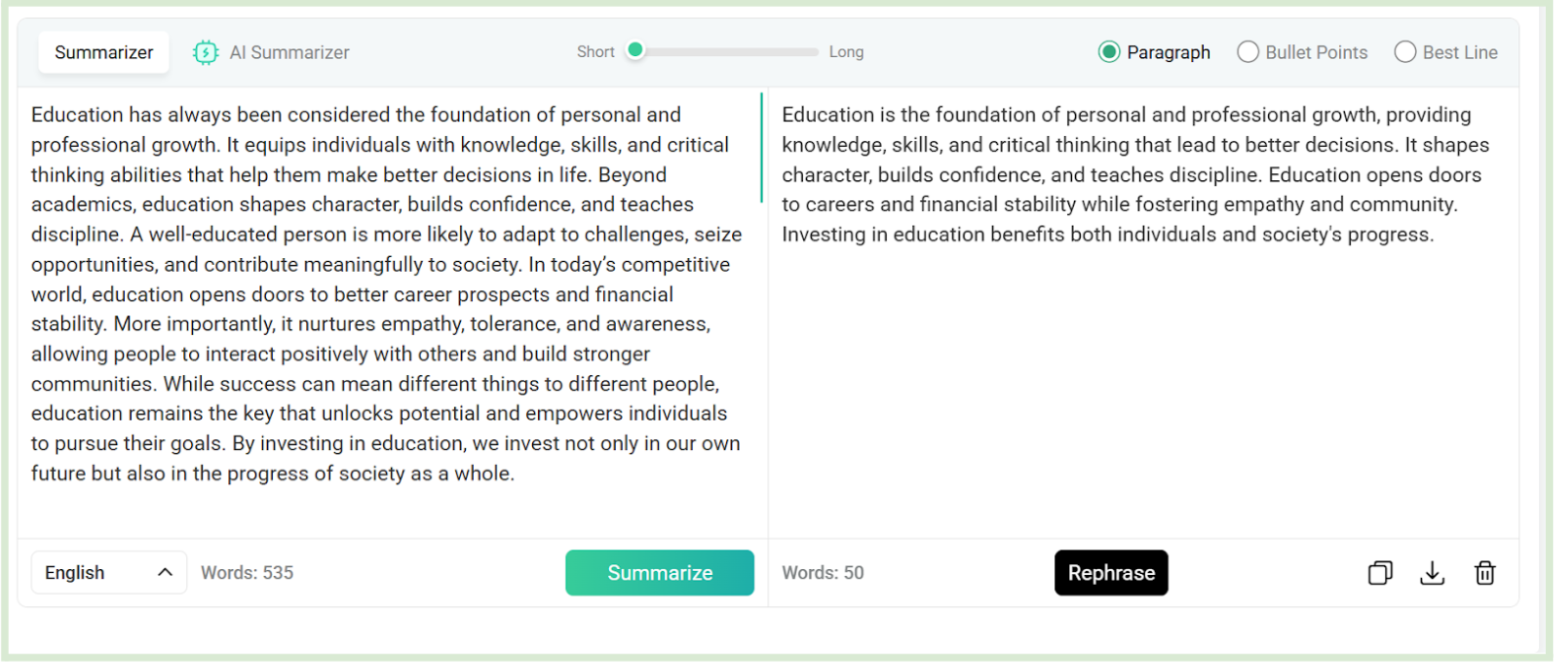
We input an essay into the tool, adjusted the length, and clicked the “Summarize” button. The AI text summarizer took no time and generated a coherent summary. As you can see the result below;
Conclusion
In this blog, we comprehensively explain the concept of summary, its main types, and practical examples to help you understand how summaries work in different contexts. It also evaluates the key elements of a summary and explains both manual as well as tool-based methods to write it. Reading this post will enable you to adopt the right type of summary for different purposes and write clear and accurate summaries.